

Why your mini split has ice on it in a Kansas winter

Step 1 of 3: Equipment

Ice on your mini split's outdoor unit in winter usually means the system is doing something normal. Every heat pump pulls heat out of cold outside air, and that process puts frost on the outdoor coil, especially on damp days when the temperature sits near freezing. A working unit runs a defrost cycle every so often to melt that off, and you may see steam coming off it for a few minutes. That's fine. What's not fine is ice that keeps building, covers the whole unit, or is still there hours later. That points to a stuck defrost control, a fan that isn't moving air across the coil, a refrigerant charge that's low, or a sensor telling the system something wrong. Kansas winters bring enough damp, near-freezing days that this shows up more than people expect. Left alone, a unit that can't defrost itself loses heat output and can strain the compressor.

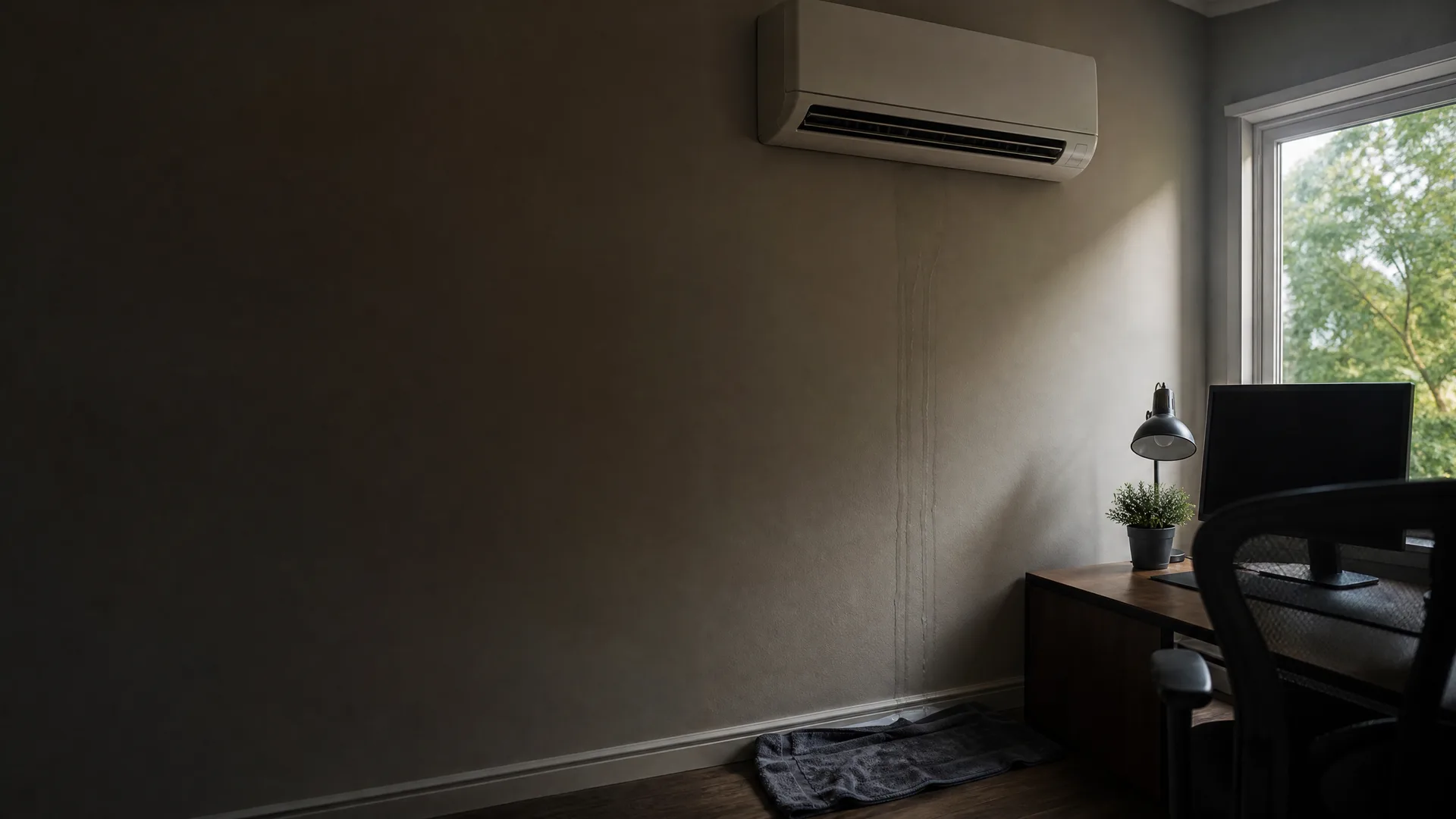
A dim room with a wall-mounted mini-split air conditioner above a faint vertical stain running down the wall, a folded grey towel on the wood floor at the baseboard, and a desk with monitor, lamp, small plant and office chair by a window.

The home office is quiet except for the space heater you dragged in last week, because you shut the mini split off when the streak first showed up on the wall. It is a July afternoon, the kind where the air outside sits thick and heavy, and the indoor unit above the desk has a dark line running down the drywall under it, drying slower than you'd like. A towel sits balled up on the floor where it caught the worst of the drip. You keep glancing at the wall between calls, wondering if it is spreading or just slow to dry, and whether the desk underneath is far enough out of the way.

Is this just frost, or has it stopped working

Walk out and look at the outdoor unit. A thin white coating that comes and goes with the defrost cycle is normal. What's not normal is a thick layer that builds up over hours, ice climbing the sides of the cabinet, or a solid sheet over the coil fins. You might hear the fan straining to turn, or notice the unit running longer than usual without the room ever getting warm. If water is pooling and refreezing underneath, or the line set going into the wall has ice on it too, the system is losing the fight against the cold instead of managing it. Left alone through a hard Kansas cold snap, that ice can crack fan blades or strain the compressor, and the room it heats keeps losing ground.

A white wall-mounted mini-split indoor unit on a light gray interior wall, with a white curtain on a black rod at left and a leafy plant in the lower left corner.

Normal defrost cycle

Here the outdoor unit runs a brief defrost, clears itself, and goes back to heating. Indoors the wall unit looks like this: clean lines, steady airflow, no ice anywhere near it. If that's what you're seeing outside too, a thin coat that comes and goes, the system is managing a cold Kansas night on its own.


A wall-mounted white mini-split air conditioner indoor unit with visible dust and grime around its outlet vent, installed near the ceiling on a plain light-colored wall.

Ice that won't quit

Grime like this on the vents and casing usually means airflow has been choked down for a while, and a starved system can't run its defrost cycle right. Ice builds instead of clearing. Left alone it coats the coil, blocks airflow further, and the unit works harder to put out less heat.

Why does my mini split keep building up ice instead of clearing it?

You already know a little ice outside is normal. What you're watching now is different. The outdoor unit ran its defrost cycle, or it looked like it tried to, and the ice is still there, maybe worse than before. In a Kansas winter, with the temperature hanging in that damp, near-freezing range for days at a stretch, that's the kind of thing that makes you wonder if the system gave up partway through.

A stuck defrost cycle usually means a sensor or valve isn't doing its job

A normal defrost cycle runs on a timer and a sensor. The system checks the outdoor coil temperature, decides it's iced over, reverses the refrigerant flow to melt the ice, then switches back to heating. When that process stalls, the usual cause is the defrost sensor giving a bad reading, the reversing valve sticking instead of switching, or the outdoor fan not running fast enough to clear the melted ice before it refreezes. Any one of those leaves the coil icing over again almost as soon as it clears, cycle after cycle. In the damp cold Kansas gets for days at a time in winter, a system doing this won't fix itself. It needs someone to find which part in that chain stopped working.

A woman in a knitted shawl sits in a living room with a fireplace, shelves, a sofa with cushions, and a lamp by a bright window, looking off to the side.
A woman with long brown wavy hair in a green shirt over a white top stands in a living room with built-in white shelves, a ceiling fan, a potted plant and a sliding glass door.
A woman with shoulder-length gray-streaked hair in a light gray knit sweater stands smiling and looking off to the side in a living room with a sofa, houseplant, framed picture, and sunlit sliding glass door.
A woman with shoulder-length curly gray hair wearing a gray knit sweater stands near a window with a sheer curtain, looking to the side, with a blurred interior room behind her.

Hand off the search today

Your request stays with one local pro.

There's no charge for the request.

A single-story gray horizontal-siding house with multiple front-facing gables, white-trimmed windows, a dark front door, and a concrete walkway crossing a partly dry lawn under a clear blue sky.

That summer dew point in Kansas averages 64°F, according to NOAA climate data. That's the muggy air your mini split has been pulling moisture out of all summer so the house feels dry instead of sticky. Come winter, the same coil that stripped that moisture out of July's air is what frosts over outside. A coil that's been working against heavy, humid air all season collects more condensation, and more condensation means more ice when temperatures drop. If your outdoor unit is carrying a thicker buildup than usual, that summer humidity is part of why.

NASA POWER T2MDEW county cells weighted by homes

A wall-mounted mini-split air conditioner indoor unit with visible dust and staining, installed on a beige interior wall below white crown molding.
Before you get your mini split repair
A white wall-mounted mini-split indoor unit high on a beige interior wall, with a potted olive-like tree at right and an armchair and window visible through a doorway at left.
After you get your mini split repair

Ice That Doesn't Clear

  • A thin coat of ice that disappears during a defrost cycle is normal for a heat pump running in a Kansas winter.
  • Ice that builds past one defrost cycle, climbs the cabinet, or blocks the fan points to a part that has failed.
  • A defrost sensor, reversing valve, or low refrigerant charge are the usual reasons a mini split stops clearing ice on its own.
  • The same outdoor coil that pulled moisture from the air all summer is the one icing over now that temperatures have dropped.
  • Running the system with a mini split stuck in a heavy ice cycle risks the compressor, so it's worth shutting it off and having it looked at.
  • A local contractor who services mini splits through a Kansas winter has likely already seen whatever is causing yours to ice over.

A little ice outside your mini split is just the machine doing its job. Pulling heat from cold Kansas air leaves frost on the outdoor coil, and a working system clears it on its own every so often and goes back to heating your home. What you're dealing with is different if the ice keeps building instead of going away, if it's climbing up the cabinet, or if it's packed in around the fan. That's not the system managing a normal cycle anymore. That's a part that isn't doing what it should. A defrost sensor that isn't telling the system when to clear itself, a reversing valve that's stuck, or a refrigerant charge that's run low can all leave ice to pile up instead of melting off. It's the same outdoor coil that spent the summer pulling moisture out of thick, muggy air so your house felt dry. Cold weather asks something different of it, and if a part inside has failed, the coil can't keep up. Running the unit through a heavy ice cycle puts strain on the compressor, which is the expensive part to replace, so it's worth shutting the system off rather than letting it keep trying. A contractor who works on mini splits through winters here has likely already run into whatever's going on with yours, whether that's a sensor, a valve, or a charge that needs checking. Once you know which kind of ice you're looking at, the next step is getting eyes on the unit itself.

A woman with her hair in a bun holds a sleeping young child against her chest, both wrapped in a textured beige knit blanket on a sofa in a dimly lit room with a lamp, framed picture, and bookshelf behind them.
An older woman with short gray hair in a cream cable-knit turtleneck sweater smiles while looking to the side in a wooden kitchen, with a round loaf of bread on a board in the foreground and a lit candle by a dark window.

Stop chasing a mini split pro

A mini split that won't clear its own ice needs a hand, not a thaw. Someone local who works on these systems every Kansas winter can tell a bad defrost sensor from a stuck reversing valve or a low charge, usually within minutes of looking at the unit. Send the request and that part of it is off your plate. One licensed contractor gets matched to your job, not a handful calling at once, so you deal with one person who already knows what tends to fail on a unit running through weather like this.

Get one local pro

Your request goes to one pro, not a list of companies.

You only hire the pro if you want to.








