
Split Systems KS

Mini split light blinking in Topeka, KS

Let a pro reach out

A blinking light on your mini split usually means it has something to tell you, but the pattern alone does not say what is wrong, and guessing can waste a trip or a part. In a Topeka summer, a mini split that is faulting is not something to sit on, and the same goes for a cold snap in January when it is pulling its share of the heat. Right now your job is probably hunting down someone licensed to work on this kind of system, calling a few, explaining the blinking, the model, how long it has been doing this, then waiting on quotes to compare. That part can be handed off. Send the form here and you are done looking. No more lining up calls, no more repeating the same details to every shop in Shawnee County, no more sorting through who actually works on mini splits and who does not. Someone who knows this equipment takes it from here.

A blinking light on your mini split is the unit's way of flagging a fault code, and most brands use the number of flashes or a color pattern to point to a specific problem, like a frozen coil, a communication error between the indoor and outdoor unit, or a drain line that's backed up. The exact meaning depends on your brand and model, since Mitsubishi, Fujitsu, Daikin and others each use their own pattern, so the same blink count can mean different things on different units. What it means for you is that the unit has already caught the problem and shut itself down or is running in a protective mode. That's good in one way, since it's not ignoring the fault, but in a Topeka summer a unit that keeps faulting isn't cooling the way it should, and the longer it runs in that state the more strain it puts on the compressor.

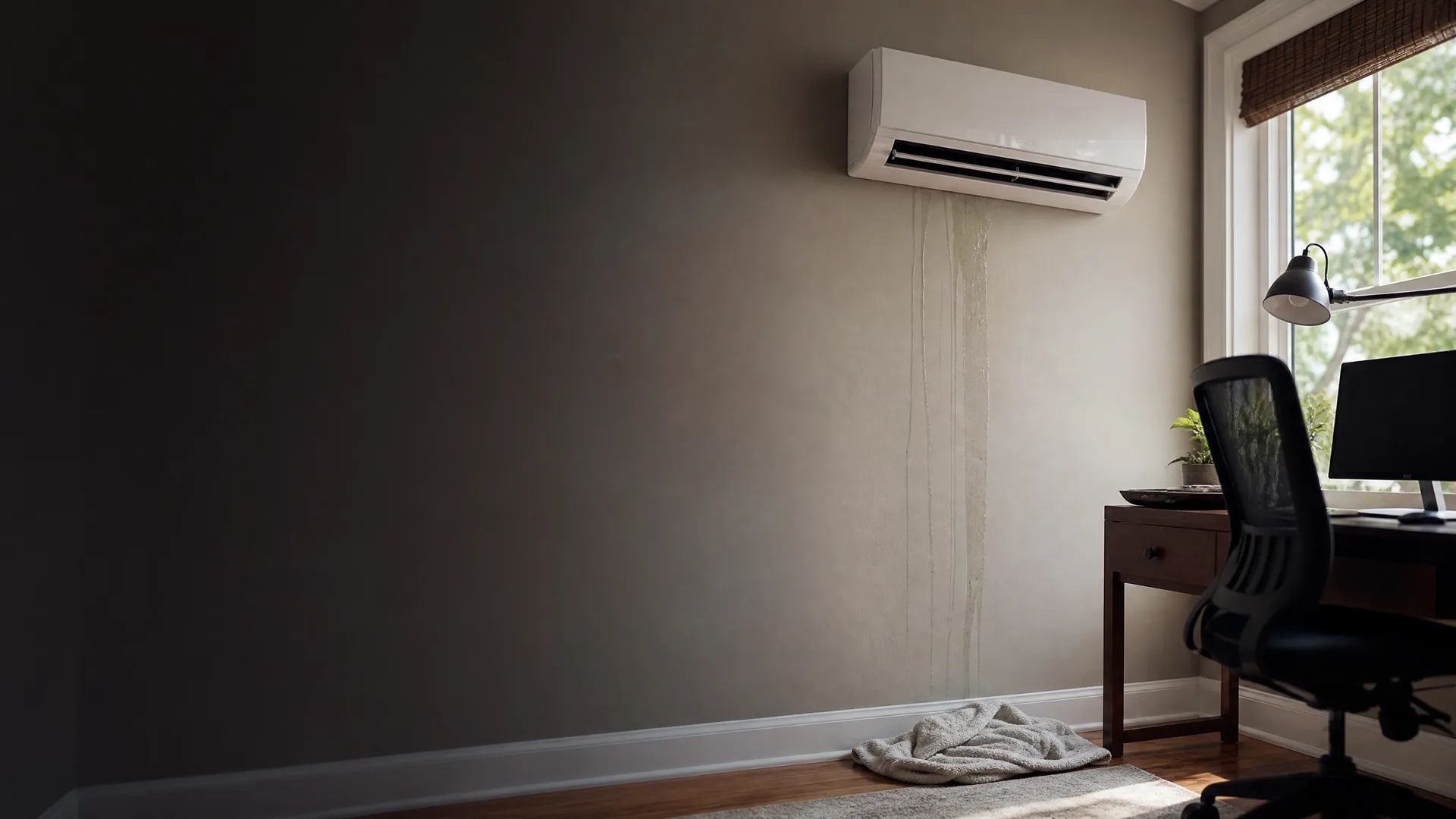
A wall-mounted mini-split air conditioner on a beige interior wall with water streaks running down below it and a towel on the floor, next to a desk, office chair and window.

You're at the desk working through the afternoon when you notice the carpet feels damp under your chair. You look up and see it, a dark streak running down the wall below the indoor unit, the paint starting to bubble at the edge. The light on the unit is still blinking, same as it's been since morning. Outside it's another sticky Topeka afternoon, the kind where you keep the windows shut and let the mini split do the work. You grab a towel from the hall bathroom and lay it along the baseboard, then another, watching the wall to see if the line is still spreading or if it's stopped where it is.

Why does your mini split work this hard in Topeka?

  • Cooling runs May through September

    Your mini split runs cooling from May through September here. That's five months of the compressor and coil working through heat and humidity, five months where a blinking light can't wait.

  • Heat runs October through April

    Heat runs October through April in Shawnee County, seven months out of the year. A mini split carrying that load has more chances to trip a fault code than one used only part time.

  • Power here costs 14.90 cents per kilowatt-hour

    Electricity in Shawnee County runs 14.90 cents per kilowatt-hour. A mini split faulting and short-cycling instead of running normally still pulls power while it struggles.

NOAA nClimDiv 1991-2020 · EIA-861 2025

Wait and watch it blink

You turn the unit off, wait an hour, turn it back on, and watch whether the light comes back. Sometimes it doesn't, and that tells you the fault was a one-time glitch rather than a part failing. But if the code returns, you've only lost time finding that out, and in a Topeka summer that's time the indoor humidity and the strain on the coil don't give back. You also still don't know which part triggered the code, so a second blink leaves you exactly where you started, just later.


Get the code read now

A contractor can read the blink pattern against your unit's brand and tell you within the visit whether it's a frozen coil, a refrigerant issue, or a communication fault between the indoor and outdoor unit. That skips the part where you search for who works on mini splits, call around to see who's free, and explain the blinking light over and over to each one. You send the details once, and the work of finding someone who can look at it falls off your list instead of staying on it while the unit keeps faulting.

A wall-mounted mini-split air conditioner indoor unit with a dusty off-white casing and dark lower vent, installed high on a plain light-colored wall below a ceiling molding.
Before you get your mini split repair
A white wall-mounted mini-split air conditioner installed high on a beige interior wall below crown molding, with a window and light curtain on a black rod at right.
After you get your mini split repair

Hand off the search today

A blinking light doesn't tell you which part to order or whether the unit needs a new board, a new sensor, or just a reset. Working that out by trial and error means pulling the cover, looking up the brand's flash code, maybe calling the manufacturer, then calling around Topeka for someone who can come out and confirm what you found. Each contractor you reach wants the story again from the start, and in July or August, with the unit down and the house holding heat, that back and forth costs you comfort you don't have to give up. Send the request once and that search is off your plate. You're not sorting through quotes or waiting on callbacks between your own work and the rest of your day. Someone who knows these units gets your situation and takes it from there. The light keeps blinking until the actual fault gets found and fixed, so the sooner that search is handed off, the sooner you're not watching it anymore.

Most mini split brands tie the blink count to a specific fault, and the pattern repeats in a loop so you can count it more than once. Five blinks might mean something different on one brand than on another.

That's why the same blink count means a frozen coil on one unit and a drainage fault on another. Matching the code to the right chart is the only way to know which part is actually at fault.

A man in a gray knit sweater stands smiling and looking off to the side beside a white marble kitchen island, with a dining table, pendant light, and open shelving in the background.
A smiling man with short dark hair and stubble in a gray sweater sits at a stone-topped counter with a white ceramic mug, in a room with a framed picture, a plant, and shelves holding bowls.
A smiling man in a dark navy sweater sits at a wooden kitchen counter with a light ceramic mug, with white tile backsplash, open shelving and a window with potted plants behind him.
A smiling man with dark hair and a beard, wearing a dark green knit sweater, stands at a kitchen counter with a ceramic mug, with an open living room, sofa, armchair and large windows behind him.
  1. The indoor unit's control board reads a sensor or signal fault.

  2. The board matches that fault to a stored code.

  3. The indoor unit's light blinks that code in a repeating pattern.

  4. The unit keeps blinking the code until the fault clears or power is cut.

Cooling runs May through September

Five months of cooling means five months where your mini split can't just shut off and wait out a problem. A blinking light in July or August is the unit telling you now, not eventually, and the longer it sits, the more that fault has a chance to turn into something bigger.

NOAA nClimDiv 1991-2020

A white wall-mounted mini-split air conditioner installed high on a beige interior wall near the ceiling, with a white-framed window at the left edge.

Running clean

This is what a mini split looks like when it's keeping up. The casing is clear, the filter behind it is clean, and the air coming off it is cold and steady. No light blinking, no streaks on the wall below it.

A dusty, stained wall-mounted mini-split air conditioner indoor unit near the ceiling on a plain beige wall, with visible lint buildup at its intake grille.

Running dirty

Dust and grime built up on the casing like this usually means the filter behind it is just as bad, and a clogged filter makes the coil behind it work harder than it should. That strain is one of the things that can trip a fault code and get the light blinking.

A closed laptop and a speckled ceramic mug sit on a wooden table beside a stoneware vase with a leafy branch, with a wooden chair, kitchen counter with cutting board and bowl, and dark upper cabinets in the dim background.

A blinking light is a code, not a verdict

A blinking light on your mini split means the board caught a fault and is telling you about it in the only language it has. The pattern points to something real, a frozen coil, a bad sensor, a communication fault between the indoor and outdoor unit, but which one it is depends on the brand and the count, and that's a job for someone who can read it correctly the first time.

Once you send the form, you're done hunting. No searching through forums for what your brand's blink pattern means, no calling around to find someone who works on your unit, no explaining the streak on the wall and the light count twice over to two different companies. Someone who knows the code shows up knowing it, and you go back to a quiet room and a unit that just runs.

A light gray sofa with gray and beige textured throw pillows and a cream knit blanket beside a white-framed window, with a small round side table holding a ceramic vase and potted greenery.
A bearded man in a dark blue T-shirt sits on a gray couch, smiling and looking down to his left, with a bookshelf and a bright window behind him.
A bearded man in a plaid flannel shirt looks out a window at snow-covered conifer trees, with a steaming ceramic mug on the sill and wooden shelves holding dishes and a plant behind him.

Mini Split Repair

Stop chasing a mini split pro

Describe your mini split job once, to one pro.

A smartphone with a blank green screen stands upright against a plain light gray background.
Step 1 of 3: Equipment