Running clean, keeping up with the cold
A mini split with a clear coil and an open vane moves the air it's rated for. On a January day in the teens, that margin is what keeps the basement from sliding below 60.

A mini split can heat a basement through a Kansas winter, but most will struggle once the temperature outside drops into the teens or lower, and Kansas gets stretches like that from December through February. A standard heat pump pulls heat from outside air, and the colder that air gets, the less heat it has to give. Below a certain point, the unit runs longer, puts out less warm air, and may need backup heat to keep the basement comfortable. A cold climate mini split, built with a different compressor for exactly this, holds its output much further down and is the right choice for most Kansas basements. If yours was installed for mild weather only, it will likely fall short on the coldest nights. The fix is matching the unit to the winter it actually has to handle.




A standard mini split draws heat from the outdoor air, and the colder that air gets, the less heat it has to give. On a Kansas day in the teens or below, the outdoor coil frosts up, and the unit has to pause and run a defrost cycle to clear it. During that cycle it's not heating your basement at all, and for a minute or two it actually blows cool air. A cold climate mini split is built differently. Its compressor runs on a variable speed drive, so instead of losing output as it gets colder outside, it ramps up to meet the load. Most are rated to keep producing real heat down to around 5 degrees Fahrenheit. That matters more in a basement than anywhere else in the house, since the concrete and the ground around it are already pulling heat out of the space. Get the indoor head sized to the room, not just the square footage but how well it's insulated, and it won't be running flat out just to keep up on the coldest nights.


Kansas winters bring stretches where the outdoor temperature sits in the teens for days at a time, usually sometime between December and February. That's when a mini split in the basement has the least to give, and the basement is where you'll feel it. If you keep the main floor at 68 with a gas furnace, the basement can drift five to ten degrees cooler once the cold settles in, especially near the outside walls where the foundation meets the coldest air. A basement used as a bedroom, office or den doesn't get a break just because the furnace upstairs is running fine. That zone depends on the mini split alone, and if the unit is undersized for the space, it will run continuously during a cold stretch without closing the gap to your thermostat setting. Add in defrost cycles, which kick in more often as it gets colder outside, and the basement gets its heat in short pulses rather than a steady flow, with small dips every time the outdoor unit pauses to clear frost. The risk isn't just comfort. A corner of the basement near a water heater or exposed pipe is the first place to feel a hard freeze if the room can't hold its temperature through the night. Sizing the mini split correctly for the basement, and for how cold it gets where you live, makes the difference between a room that holds steady and one that falls behind every time the weather turns.


A basement in Kansas sits below grade with cold ground pressing against the walls, and that works against a mini split on the coldest nights of the year. Once outdoor temps fall into the teens, the unit is already losing output and cycling into defrost, right when that below-grade space needs steady heat to hold 68. The fix isn't the mini split itself, it's whether the one installed was sized and placed for that basement in a Kansas winter, not just for the square footage. A contractor who installs mini splits in your area can size the unit for how cold it actually gets where you live and where the basement loses heat fastest. Getting that matched up now, before the next cold stretch, means you're not troubleshooting a cold room in January. Send the request and the search for the right contractor is off your plate.
A cold climate mini split uses a different compressor and a larger outdoor coil, so it keeps delivering heat at temperatures that would stall a standard unit. Where a standard system starts losing real capacity around freezing, a cold climate model holds most of its rated output down to 5 degrees and keeps running, in a reduced way, well below that. For a Kansas basement, that difference lands in January and February, when outdoor temps sit in the teens or lower for days at a stretch. Check the spec sheet for capacity at 5 degrees, not just the headline number for 47 degrees. That lower number tells you what the unit actually does on the night you need it.
A basement loses heat through its walls and slab all winter, not just during cold snaps, because the ground around it stays far colder than the air inside. That steady loss is part of why a mini split sized only for a mild day falls short once outdoor temps drop and stay down. Sizing has to account for the basement's exposed wall area and how much of it sits below grade, not just the square footage. An installer who measures the space and runs a load calculation before quoting equipment is giving you a number you can hold them to, rather than a guess based on the room size alone.



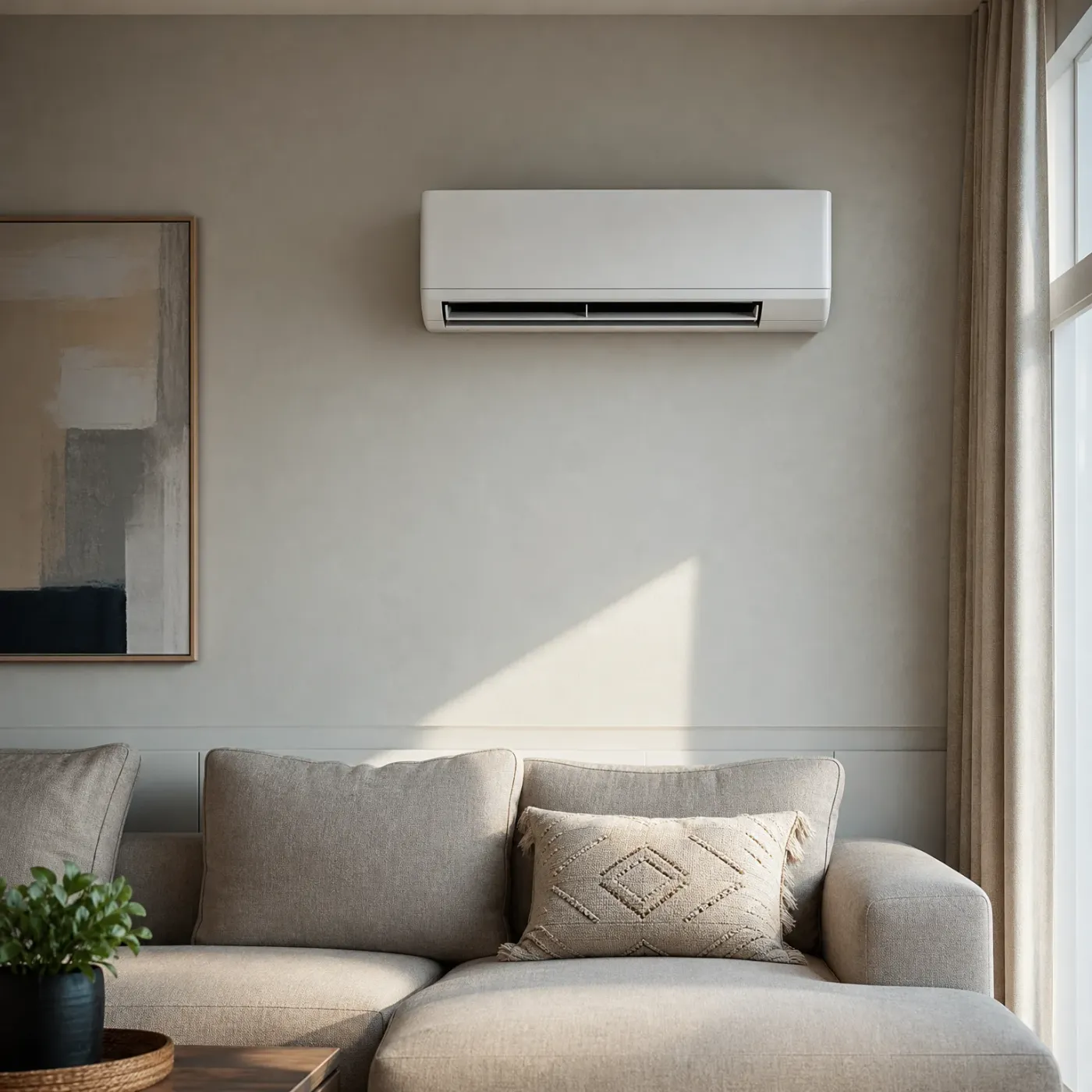
A mini split with a clear coil and an open vane moves the air it's rated for. On a January day in the teens, that margin is what keeps the basement from sliding below 60.

Grime on the housing usually means grime on the coil behind it. A unit fighting through buildup already has less heat to give, and a cold snap is when you'll notice it's not keeping up.
At 14.44 cents per kilowatt-hour, running a mini split hard through a cold snap costs real money, especially a standard unit stuck in defrost and leaning on backup heat to hold the basement. A properly sized, cold climate system gets more heat for that same rate.
EIA-861 2025 statewide residential average

A mini split with a clear coil heats evenly and moves the air it's rated for. In a basement, that steady output is what holds the room at temperature when the ground outside is cold and the air upstairs is dry.

Dust built up on the panel and louvers blocks airflow across the coil. A unit working that hard to heat a Kansas basement in January can't spare the capacity, and the room falls behind.

That 64°F dew point is a summer number, and it's why your mini split earns its keep from June through August even though this page is about winter. Air that heavy makes the unit's cooling mode work harder to pull moisture out, not just drop the temperature. A basement with a mini split stays dry and comfortable through a muggy Kansas summer precisely because the same equipment that struggles on the coldest winter nights has no trouble wringing water out of thick summer air. It's the other half of what you're paying this unit to do.
NASA POWER T2MDEW county cells weighted by homes

A standard mini split will keep a Kansas basement warm most of the winter and fall short once outdoor temps sit in the teens for days at a stretch. A cold climate unit, sized for the room and running on a clean coil, holds its output through that same stretch. That's the difference between a basement that drifts into the 50s during a cold snap and one that doesn't.
If you're not sure which one you have, or whether yours was ever sized for the space, that's worth sorting out before the next cold snap rather than during it. Send in what you know about your basement and your current setup, and a contractor who works on these systems in this area will reach out to look at the specifics with you. You don't have to figure out the sizing or the equipment yourself first.

One request ends the search for a mini split installer.
You're not committing to anything by asking.