Can a mini split cool a whole house in Hutchinson, KS

Hand it off

A single mini split head is built for the room it's in, not the whole house. Whether one can cover your place depends on how your home is laid out, how many zones you'd need, and how the unit matches up against a Reno County summer that doesn't let up. That's a sizing and design question, not a guess, and it's worth getting a straight answer before you spend money assuming it'll work or assuming it won't. Instead of calling around Hutchinson to find someone who'll actually walk through your home and look at what you've got, send the form here. You stop chasing down installers, repeating the same details to each one, and sorting through quotes that don't match up. Once it's sent, someone else is doing the legwork of finding a contractor who installs mini splits in this area. That part is off your plate.

A single mini split can cool a whole house, but usually not with just one indoor head. Each head is sized and placed to condition the room it's in, so a one-zone system cools that room well and leaves the rest of the house to whatever heat finds its way in. Covering a whole house means a multi-zone setup, with a head in each main room or a few strategically placed to reach the others, sized against your square footage and how the rooms connect. That matters more here than somewhere mild, because Hutchinson summers run hot and sticky for months, and a system that's undersized or missing a zone will struggle right through August. Whether your place needs two heads or five, and where they go, comes down to your layout. That's a job for someone who can walk the house and size it room by room.

So what does a mini split actually have to work against here?

  • Cooling runs May through September

    May through September, that's five months your indoor heads run to hold a room, not just a hot afternoon. A system sized light shows it over the whole stretch.

  • Heat runs October through April

    Seven months of heat means the same heads you're counting on for summer are carrying the load most of the year if you're running a heat pump setup. Sizing has to work both directions.

  • Power here costs 14.49 cents per kilowatt-hour

    At 14.49 cents a kilowatt-hour, a system with too many heads trying to cover rooms they weren't matched to runs longer than it should, and you feel that on the bill every month, not just in August.

NOAA nClimDiv 1991-2020 · EIA-861 2025

One zone, one room done right

A single-zone mini split in the living room will hold that room at whatever temperature you set, right through a Reno County summer. The bedrooms down the hall, the kitchen, the upstairs if you have one, stay out of its reach. Warm air moves toward cool, so rooms next to the one with the head will run a few degrees better than rooms farther away, but none of them get held the way the room with the head does. If the house is small and open, one head might reach most of it. If it's split into separate rooms with doors that close, one head covers one room.

A multi-zone system built for the house

Covering the whole house means a multi-zone system, one outdoor unit feeding an indoor head in each room or zone that needs its own cooling. A bedroom wing gets its own head, the main living space gets another, and each one is sized for the room it's in rather than for the house as a whole. That's how a mini split actually takes on a full house instead of just the room it sits in. Getting the zone count and the sizing right for your layout is what decides whether the system holds every room through August the way a single head holds the one it's in.

A man in a blue sweatshirt reclines with closed eyes in a brown leather armchair in a living room with a bookshelf, houseplant, sofa, window, and a side table holding newspapers and a dark mug.
A bearded man in a gray pullover reclines with closed eyes on a brown leather sofa in a sunlit room with a window, framed picture, potted plant, and a wooden cabinet holding papers and a dark mug.
A man in a gray sweater leans back with closed eyes in a brown leather armchair beside a wooden side table holding a dark mug and a folded newspaper, with bookshelves and a window seat behind him.
A man in a green sweater reclines in an armchair with his eyes closed and a slight smile, beside a window with plants, a small table holding a mug and folded newspaper, and bookshelves behind him.
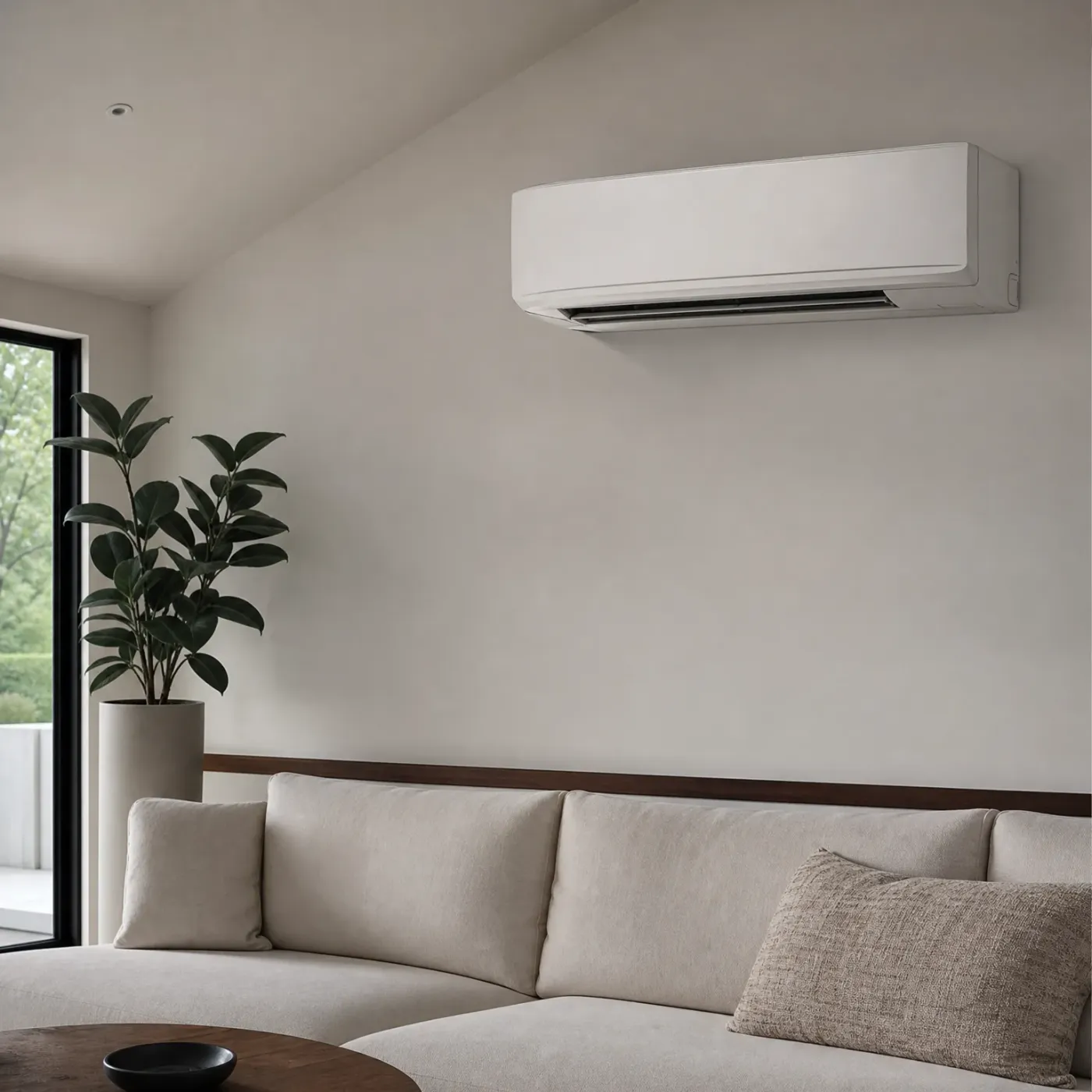
A white wall-mounted mini-split air conditioner near the sloped ceiling of a living room with a light sectional sofa, cushions, a potted plant, and a window showing greenery.

Done looking for a mini split pro

Skip the round of in-home estimates for a new mini split.

One request ends the search for a mini split installer.

Hand off the search

You're not committing to anything by asking.

A white wall-mounted mini-split air conditioner installed high on a beige interior wall below crown molding, with a window and light curtain on a black rod at right.
One head, sized right, keeps up with a Kansas summer in the room it was placed for, no matter how hot July gets.
A wall-mounted mini-split air conditioner indoor unit with a dusty off-white casing and dark lower vent, installed high on a plain light-colored wall below a ceiling molding.
A unit this dusty is losing airflow it needs to keep that room cool, let alone carry the rooms around it.

How multi-zone systems actually cool a house

  • Each indoor head has its own refrigerant line and its own thermostat sensor, so it only reads and reacts to the room it hangs in.
  • One outdoor compressor can run two, three or more indoor heads at once, which is what turns a single-zone setup into a whole-house one.
  • A multi-zone system still needs enough total capacity for every room running on a July afternoon, not just the sum of each room's peak.
  • The compressor modulates its speed, so it can idle through a mild morning and ramp up hard once a Reno County afternoon gets going.
  • Line sets run through small holes drilled near each indoor head, which is how zones reach bedrooms or additions without new ductwork.
  • A design that skips a load calculation for each room tends to leave one or two spaces short no matter how many heads are installed.

A multi-zone mini split works off one outdoor compressor feeding several indoor heads, and each head runs on its own. The one in the bedroom reads the bedroom's temperature and acts on it. The one in the living room does the same for that room. Neither knows or cares what the other is doing. That's the part that makes whole-house coverage possible: it's not one unit straining to cool everything, it's several units each doing one job, tied to a compressor sized to run them together.

Getting there takes more than adding heads. A contractor has to work out how much heat each room picks up on a July afternoon in Reno County, then size the outdoor compressor to cover all of those rooms running at once, not just whichever one is loudest. Skip that step and the system still looks right on paper. It's the spare bedroom that never quite cools, or the kitchen that falls behind once the oven's on and the sun's hitting that side of the house.

The compressor itself doesn't run at one speed. It idles low on a mild morning and ramps up as the afternoon heat builds, matching output to what the house actually needs at that moment. And because each zone runs its own small refrigerant line through a hole drilled near the indoor unit, rooms that would be hard to duct can still get their own head, which is usually how additions and bedrooms down the hall end up covered at all.


A dusty, stained wall-mounted mini-split air conditioner indoor unit near the ceiling on a plain beige wall, with visible lint buildup at its intake grille.
Before you get your mini split installation
A white wall-mounted mini-split air conditioner installed high on a beige interior wall near the ceiling, with a white-framed window at the left edge.
After you get your mini split installation

Closing off a doorway helps a little

Shutting the door to a room a single head doesn't reach keeps some of that cooled air from drifting out, but it doesn't bring cold air in. The hallway and the rooms past it still have only whatever heat makes its way through the walls and under the door. A fan can push air a few feet further down a hall. It can't carry it through a closed house, and it does nothing about the humidity building up in a room with no head of its own.

A second head changes what the system is

Add an indoor head in the bedroom or upstairs and the outdoor compressor is now running two zones off one line set, not one room stretched thin. Each head still reads only its own room, so the living room holds its setting and the bedroom holds its own. This is how a mini split starts to cover a Reno County house room by room instead of one room well and the rest left to whatever heat gets in.

Cooling runs May through September

Five months is a long stretch to ask one head to carry rooms it was never placed for. If your mini split only covers the living room, the rest of the house rides out May through September on whatever air finds its way there.

NOAA nClimDiv 1991-2020

A closed laptop and a ceramic mug of dark coffee sit on a wooden table, with a blurred kitchen counter, potted plant, wooden utensils and cutting boards, and a large window in the background.

So, can one cover the whole house

Only if it has enough heads to reach every room, sized and placed for how your house is laid out. One indoor head cools the room it hangs in, well, through all five months of a Reno County summer. It won't carry the rest of the house no matter how long you run it.

If you're trying to figure out how many zones your place actually needs and where they should go, that's a question for someone who can walk through the house and work it out room by room. Sending the form means you're not the one calling around, explaining the layout to three different contractors, and sorting through quotes that all size it differently. That part is off your plate once it's sent.

A gray upholstered sofa with a beige cushion and knit blanket beside a curtained window, with a white mug and a book on a dark wooden table in the foreground and a lit lamp in the background.
A gray-haired man in a blue quarter-zip sweater sits in an armchair with his eyes closed, beside a large window with bare trees outside and a potted plant and lamp nearby.
A woman in a cream knit sweater sits in an armchair with her eyes closed and head tilted back, beside a window showing orange autumn foliage and a wooden side table with a mug.

Mini Split Installation

It's off your list after this

Describe the project once instead of to every installer.

A black-framed smartphone standing upright against a plain white background, its screen filled with solid green.
Step 1 of 3: Equipment