Profile view of a bearded man wearing a black baseball cap and a dark gray T-shirt against a plain light background.

Best mini split setting for a Kansas winter

Step 1 of 3: Equipment

What temperature should I set my mini split at in winter?

Kansas winters swing cold enough that a mini split has to work for its keep, and most homes here still lean on gas for the furnace. If you're running a mini split as backup or for one room, it's worth knowing what setting actually keeps it efficient instead of just guessing and hoping the bill looks right.

Set it between 68 and 70 degrees and leave it there

A mini split works best holding a steady temperature rather than being bumped up and down through the day. Set it between 68 and 70 degrees and let it run. Every time you raise the setting a lot after letting the room go cold, the unit has to work harder to catch up, and in freezing weather that strain shows up fastest in the parts that are already weakest. Kansas winters bring stretches of real cold, and a mini split that's cycling hard against big temperature swings wears on its coil and its defrost cycle faster than one holding steady. If your unit is backing up a gas furnace, keeping it level also means it's not fighting the furnace for the same room.

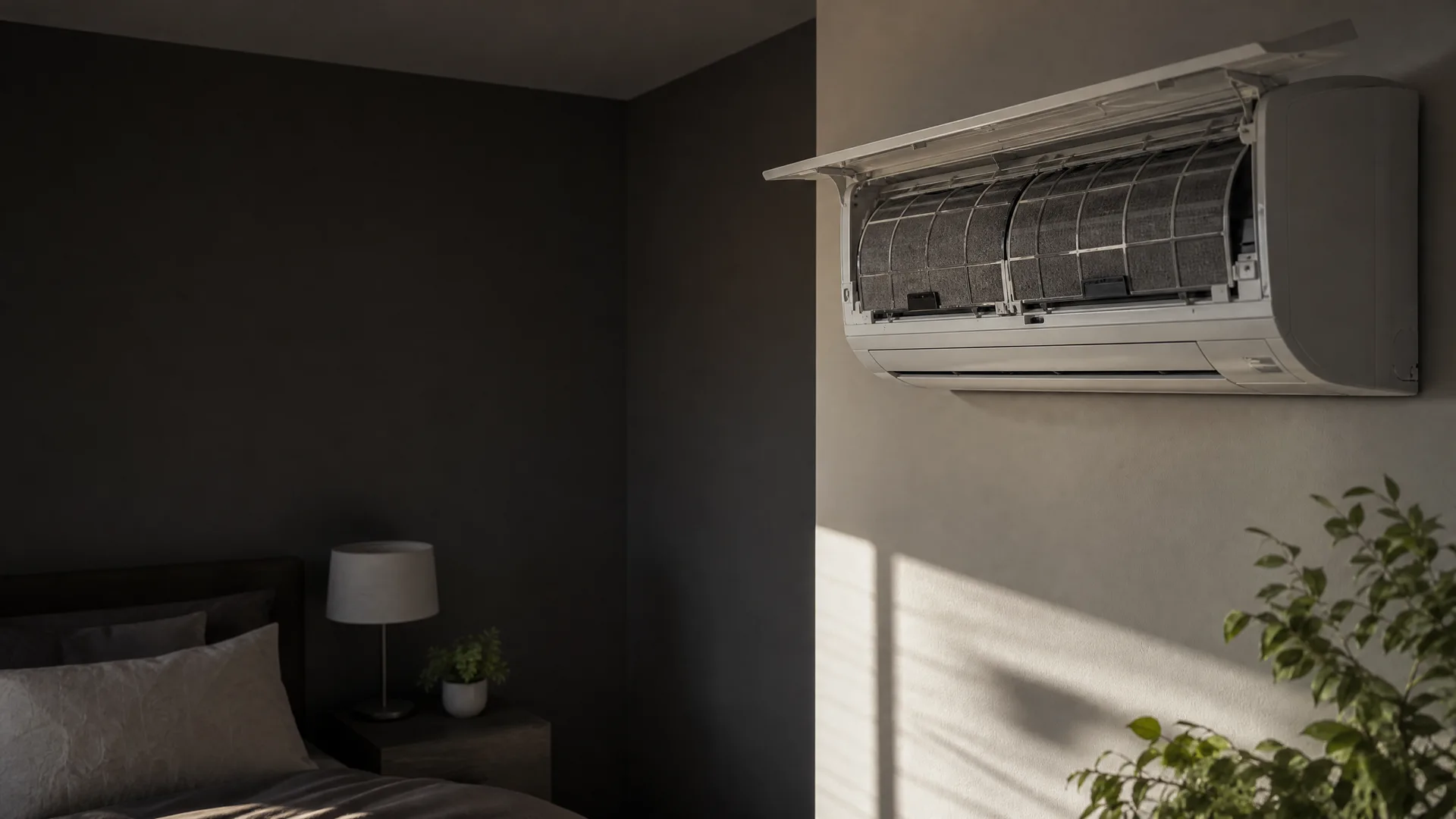
A wall-mounted mini-split air conditioner with its front cover open exposing the filters, in a dim bedroom with a bed, nightstand lamp and a potted plant.

Spring finally breaks through, warm enough that you shut the mini split off in the bedroom for the season. You pop the front cover to wipe it down before summer and the filter screen is grey with dust, the kind that settles in slow over a whole winter of running. You had it set low and steady since October, and the unit was pulling air through that screen the entire time. It still worked. The room still got warm. But looking at it now, you can see what a clogged filter does to a system nobody checked on for months. You make a note to pull it every few weeks once the heat kicks back on.

Steady Setpoint or Set It Back

Set it and leave it

  • Pick one temperature for the room you're heating and hold it there through the cold months instead of chasing comfort by hand.
  • The outdoor unit works steadiest when it isn't responding to big jumps, so a fixed setpoint keeps the compressor cycling in a normal range.
  • You'll notice fast if something's wrong, because the room drifting off that number means the unit is struggling, not the weather.
  • Less cycling up and down means less wear on the parts that start and stop the system each time it kicks on.
  • Easier to tell your contractor what changed, since you know what it was set to the week before it started running warm air that isn't warm enough.

Lower it when you're out

  • Dropping the temperature a few degrees when the room's empty for hours saves the unit from heating space nobody's using.
  • A mini split recovers a dropped room slower than a furnace does, so coming home to a cold room and cranking it up hard works the system harder than holding steady would have.
  • If the room is the one with the mini split as backup, this matters less, since the furnace is likely carrying the rest of the house anyway.
  • Swinging the setpoint up and down through a Kansas cold snap asks more of the compressor than a steady low temperature does.
  • Worth doing only if you're disciplined about it, since forgetting to lower it back defeats the point and just adds a cold room to deal with.
A white wall-mounted mini-split air conditioner near the ceiling of a room with light gray walls, white crown molding, and a beige curtain at the left edge.

Running clean

This is what a mini split should look like through a Kansas winter. The wall stays clean, the case stays white, and the air coming off it doesn't carry any smell. That's a unit whose filter gets checked and whose coil isn't choked with dust.

A dusty beige wall-mounted mini-split air conditioner indoor unit installed high on a plain light-colored wall below the ceiling.

Running dirty

Dust and grime like this build up over a winter of steady use, and the staining on the wall shows air leaking around the case instead of moving through the filter. A unit left like this is working harder for less heat, and that grime is headed into the air in that room.

Why does my mini split sound like it's straining lately?

You might notice the indoor unit running longer than it used to just to hold the same room at the same temperature. The fan might sound louder, or you hear a clicking when it kicks on. Maybe there's a faint musty smell when the air first starts moving, or the wall behind the unit has a thin grey line building up on it. None of that is normal wear, it's the coil or filter fighting through dust that's built up over the winter. Left alone, the unit pulls more power to do the same job, and in a Kansas winter that means a higher bill every month it keeps running dirty. A unit that's straining now is also more likely to need a repair call before spring.

Single-story house with tan horizontal siding and a dark shingled hip roof, fronted by a patchy green and brown lawn and a concrete walkway leading to the covered entry.

Kansas summers run a dew point of 64°F across June, July and August, a NOAA average for where homes sit in the state. That's heavy, sticky air, and it's the same air your mini split's outdoor coil has to shed moisture from all summer before it ever gets to winter. Humid air leaves more behind on that coil, and whatever builds up there now is what makes the unit strain once you switch it over to heat. A coil that got checked and cleaned before the cold set in runs quieter and doesn't fight to hold your set temperature. Send in the form and a local contractor who services this equipment every season takes it from here, so you're not the one tracking down who's free this week.

NASA POWER T2MDEW county cells weighted by homes

Send one request and you're done looking

Only one pro gets your request, so you hear from one company.

There's no charge for the request.

How a mini split actually heats

A mini split doesn't make heat the way a furnace does. It pulls warmth out of the outside air and moves it inside, even when it's cold out, because the refrigerant inside the outdoor unit can still pull heat from air well below freezing. That's why holding a steady setpoint matters more than it does with gas heat. Every time the system has to recover from a big setback, the outdoor unit has to work harder to pull that heat back in, right when the air it's pulling from is coldest. A furnace just fires the burner longer. A mini split has to do more to get the same jump.

What frost on the coil means

On a cold morning you might see the outdoor unit's coil covered in frost, and a defrost cycle will run to clear it. That's normal. What's not normal is frost that never clears, or a unit that seems to be defrosting constantly. That usually points to a dirty coil, a fan that's not moving enough air across it, or a refrigerant charge that's off. Someone who services these units every winter in Kansas knows which of those three is most likely before they even pull the cover off, because they've seen the same pattern on other systems running the same cold snap.

A smiling man in a gray long-sleeved shirt stands in a kitchen looking to the side, with open shelves of dishes, a white mug on the counter, a potted plant, and a view through a doorway into a living room.
A smiling bearded man in a green sweater sits at a white marble kitchen island with a mug, potted plant and bowl of fruit, in a bright white interior with open shelving and an arched doorway.
A smiling man with dark curly hair and a beard, wearing a dark green knit sweater, stands at a white marble kitchen counter with a dark blue mug, with open shelving, pendant lights and a houseplant behind him.
A smiling man in a green ribbed sweater stands behind a wooden table holding a ceramic mug of coffee in a kitchen with white subway tile, shelves of potted plants, and a bowl of fruit.

Running it as backup heat only when gas furnace struggles below freezing means the mini split sits idle most of the winter, then has to work hardest on the coldest nights of the year.

Running it steady on mild days and letting the furnace carry the deep cold spreads the load instead. The mini split handles the easy hours, the furnace takes over when it actually gets hard.

A smiling man with dark curly hair in a navy t-shirt sits on a gray couch indoors, with a large-leafed plant and a window in the background.
A bearded man in a plaid flannel shirt stands in a kitchen looking out a window toward snow-covered shrubs, with a steaming mug on the windowsill and potted plants on a shelf behind him.

Checked every fall

A local pro clears the filter and coil before the cold sets in, so the unit isn't working against dust all winter. One visit catches what your eye can't.

Send my request

Never looked at

The unit keeps running, but quieter failures build underneath: a dirty coil, a weak drain, a filter choked with a winter's worth of dust. You find out when it struggles.

Send my request

Power costs 14.44 cents per kilowatt-hour statewide

At 14.44 cents a kilowatt-hour, a mini split left to idle or run dirty filters shows up on the bill fast, since it's drawing power the whole time it's fighting restricted airflow. A clean filter and coil keep it pulling the heat it should for the power it uses, instead of running longer to make up for the dust.

EIA-861 2025 statewide residential average

A mini split through a Kansas winter does best held at one steady setpoint, with the furnace there for the hard cold below freezing, and a filter and coil that get checked before the cold sets in. That's the whole answer. The part that's easy to put off is the checking, and it's the part that decides whether the unit is pulling heat cleanly or straining against dust you can't see from across the room. A local contractor who works on these systems all season knows what usually gives out first on a unit that's sat through a few Kansas winters, and checks that before it turns into a repair call. You'd only be matched with one, so it's a single visit from someone who knows this equipment, not a string of calls to sort through. If your mini split has been holding its temperature without much fuss, you're already most of the way there. If it's been running longer and louder to do the same job, that's worth having someone look at before the next cold snap, not after.

A dark wood cabinet with a paneled door and a ceramic pot of green foliage on top stands in a beige-walled room with white baseboard, a window at left, hardwood floor, and a patterned area rug.
A dark wood glass-front cabinet holding folded towels, woven baskets and a ceramic vase stands in a bathroom corner beside a window, with a potted fern and stacked towels on top and a freestanding tub partly visible at left.
A woven basket holding a green cushion and a cream fringed knit throw sits on a wood floor in a room corner beside a window and a dark wooden cabinet.
Corner of a room with a dark wood cabinet topped by a round vase, a linen curtain at a window, white baseboard, oak plank flooring with sunlight patches, and a woven jute rug in the foreground.
A dark wood sideboard against a pale wall holds a shallow stone bowl and a round ceramic vase with leafy branches, with sunlight from a curtained window falling across the wall, wood floor and woven rug.

Let someone else find the pro

A licensed local pro takes the request for your mini split tune-up.

Find a licensed pro

Asking costs nothing, and the choice to hire stays yours.














